







FinTech & Financial Software Development

CodeBuzzers designs and develops secure, scalable financial applications, FinTech platforms and custom financial software for businesses building the next generation of digital finance.

  • Payments & wallets
  • Banking & lending
  • Financial dashboards
  • Secure by design
Toll Care Assistant app iconShipped by CodeBuzzers · live on Google PlayToll Care Assistant — FASTag issuance & management
Financial Operations
Demo data

Available balance

₹ 2,18,47,099

Inflow · 30d

₹ 4.62 Cr

Outflow · 30d

₹ 3.18 Cr

Net position

₹ 1.44 Cr

Cash flow · last 30 daysNet + ₹ 1,44,20,000
Risk check passed₹ 4,82,600
Recent transactionsView ledger
  • Meridian Retail Pvt LtdTXN-90418 · UPI · Collect+ ₹ 4,82,600Settled
  • Payout · Vendor batch 14TXN-90417 · IMPS · Bulk− ₹ 1,17,250Settled
  • Northwind LogisticsTXN-90416 · Card · Visa+ ₹ 92,400Settled
  • Subscription renewalsTXN-90415 · Auto-debit+ ₹ 2,36,180Settled
Your accountDemo data

₹ 84,210

+ ₹ 4,826 this week

Payment received

₹ 4,826 · Meridian Retail

Financial products, platforms and systems we build

  • Digital Banking
  • Payments
  • Wallets
  • Lending
  • Investment
  • Wealth
  • InsurTech
  • Accounting
  • AI in Finance
  • Financial APIs
The opportunity

Financial Software Should Do More Than Process Transactions.

Most finance teams are not short of software. They are short of software that agrees with itself — one platform where a payment, a customer, a ledger entry and a report are the same event seen from different angles.

Finance team working through results in an office

We build financial software around the way your business actually operates.

Not around the way a licensed product assumes it should.

  1. 01

    Systems that do not talk to each other

    Payments sit in the gateway, customers sit in a CRM, ledgers sit in accounting software, and reconciling the three is somebody’s week. The data exists; it has just never been in one model.

    What we build
    CodeBuzzers

    One connected financial platform

    A single source of truth for customers, transactions, balances and documents, with every downstream system reading from it rather than keeping its own copy.

  2. 02

    Manual work standing in for software

    Approvals over email, reconciliation in spreadsheets, statements assembled by hand, KYC documents chased over WhatsApp. It works until volume doubles, and then it does not.

    What we build
    CodeBuzzers

    Workflows that run themselves

    Automated reconciliation, rule-based approvals, scheduled reporting and document processing — with the exceptions escalated to a person instead of the whole queue.

  3. 03

    Numbers that arrive too late to act on

    Month-end closes tell you what happened five weeks ago. By the time a cash-flow problem is visible in a report, the decision that would have prevented it has already been made.

    What we build
    CodeBuzzers

    Live financial visibility

    Dashboards built on the live transaction ledger — position, exposure, collections and cash flow as they stand now, for the people who actually make the call.

  4. 04

    A customer experience that feels like paperwork

    Onboarding that takes days, a payment flow that drops people at the last screen, and no way for a customer to answer their own question at 11pm without calling support.

    What we build
    CodeBuzzers

    Financial products people finish using

    Fast onboarding and verification, payment flows designed against real drop-off points, and self-service that resolves the question instead of routing it.

How it fits together

One Financial Platform. Every Transaction Connected.

Customers, money and instructions come in on the left. Risk, security and AI sit above the platform and inspect everything passing through. What comes out on the right is a ledger that balances, analytics you can act on, and a report you did not have to assemble.

Inputs

  • CustomersOnboarding, KYC, profiles
  • PaymentsCards, UPI, wallets, transfers
  • BankingAccounts, balances, statements

Governance

  • RiskLimits, scoring, exceptions
  • SecurityAuthentication, access, audit
  • AIDetection, prediction, assistance

Records

  • TransactionsThe single event ledger
  • CRMRelationships and servicing

Outputs

  • AccountingPostings, reconciliation
  • AnalyticsPosition, exposure, cohorts
  • ReportingStatements and disclosures

What happens to a single payment

Four states. Every one of them is recorded, and every one is reversible in the audit trail.

  1. 01

    Payment initiated

    Customer authorises. Request enters the platform with an idempotency key.

  2. 02

    Processing

    Routed to the gateway or rail. Provisional entry written to the ledger.

  3. 03

    Verified

    Risk rules and limits evaluated. Exceptions escalate; the rest continues.

  4. 04

    Completed

    Settlement confirmed, ledger finalised, accounting posted, customer notified.

What we build

Financial Software Built Around Your Business Model.

One platform, configured for the way your money actually moves. Pick a model and the console below changes to what that business needs on day one.

Banking Console
Demo data

Digital Banking Platform

Account opening, balances, transfers, statements and cards in one customer application, with the servicing console the operations team works from behind it.

Accounts

48,210

Deposits

₹ 312 Cr

Active today

11,904

Deposits · 12 months
Account activity
  • Fund transfer · NEFTA/C ••4192− ₹ 1,20,000Completed
  • Salary creditA/C ••7730+ ₹ 2,84,500Completed
  • Account openedKYC verifiedNewActive
  • Standing instructionMonthly · 5th− ₹ 18,000Scheduled
  • Digital onboarding and KYC
  • Multi-account and multi-currency
  • Transfers, standing instructions, mandates
  • Card issuance and controls
  • Statements and e-documents
  • Servicing console for operations

FinTech products we are asked for most

Built as products, not modules bolted on
  • Digital wallets
  • Payment gateways
  • Lending platforms
  • Investment platforms
  • Insurance platforms
  • Expense management
  • Accounting software
  • Financial dashboards
  • Subscription billing
  • Wealth management
  • Neobank experiences
  • Cross-border payments
  • Reconciliation engines
  • Customer onboarding & KYC
  • Invoicing & receivables
  • Payouts & disbursals

Not sure which of these your product actually is?

Most are a combination. Tell us how money moves through your business and we will map it to a platform shape, a build sequence and a realistic first release.

Product experience

Financial Products Designed for Real People.

Financial software fails at the same two places: the screen where somebody has to be verified, and the screen where somebody has to understand a number. We design both before we build either.

Financial Dashboard · Web
Demo data
Financial operations dashboard open on a laptop screen
The console your team lives inPositions · ledger · exceptions · approvals
Mobile banking application open on a smartphone
Customer appBalance, movement and the next action — visible without scrolling.
Customer paying by card at a point-of-sale terminal
Payment interfaceCheckout designed against the real drop-off points.
Investment platform showing market performance on screen
Investment interfaceHoldings and performance a client can read unaided.
Admin Platform · OperationsDemo data
Financial analytics screen showing revenue and transaction charts
Admin platformRoles, limits, audit trail and every override recorded against a person.

The five screens every financial product is judged on

Everything else can be iterated. Lose someone here and they do not come back to try again.

  1. 01

    Sign up

    Minimum fields, saved progress, no dead ends on a phone.

  2. 02

    Verify

    Identity and document checks that finish in the app, not over email.

  3. 03

    Transact

    Pay, transfer, invest or claim — the action the product exists for.

  4. 04

    Analyse

    Position, history and trends the customer can read without help.

  5. 05

    Manage

    Limits, mandates, documents and support, self-served.

Shipped work
Toll Care Assistant app icon

Toll Care Assistant

FASTag issuance & management · built by CodeBuzzers

A live Android product for the people who actually issue and service toll tags. It handles the whole working day in one app: sign in on a phone number, assign a FASTag to a vehicle, recharge one that has run down, see what stock is left in each vehicle class, and pull the issuance report at the end of the month.

In the publisher's own words on the store listing: “TollCare is simplifying your toll-related needs on the go.”

View on Google PlayReal product · real screens
Publisher
Toll Care
Platform
Android
Store category
Auto & Vehicles
Package
com.tollcare.fastag
Toll Care Assistant sign-in screen, with mobile number entry and OTP verification
Sign inMobile number and OTP — no password to forget or leak.
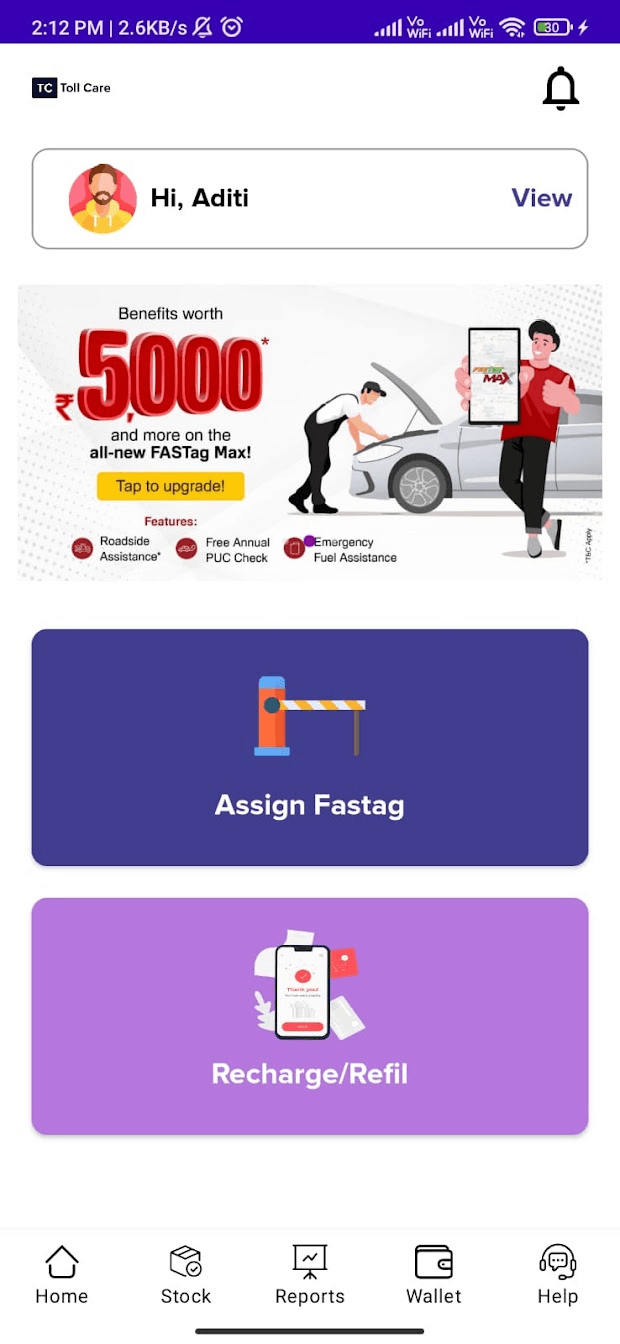
Toll Care Assistant home screen, showing the Assign FASTag and Recharge or Refill actions
HomeThe two actions the job is made of: assign a tag, or recharge one.
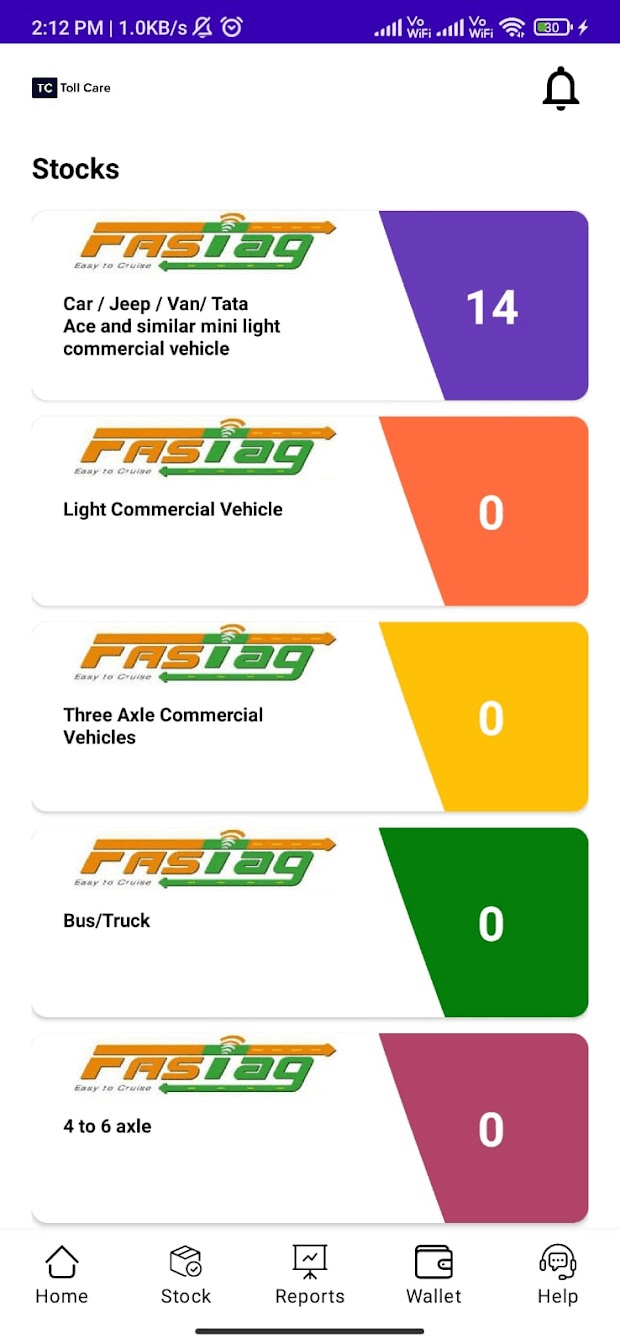
Toll Care Assistant stock screen, listing available FASTag inventory by vehicle class
StockLive FASTag inventory, counted separately for each vehicle class.
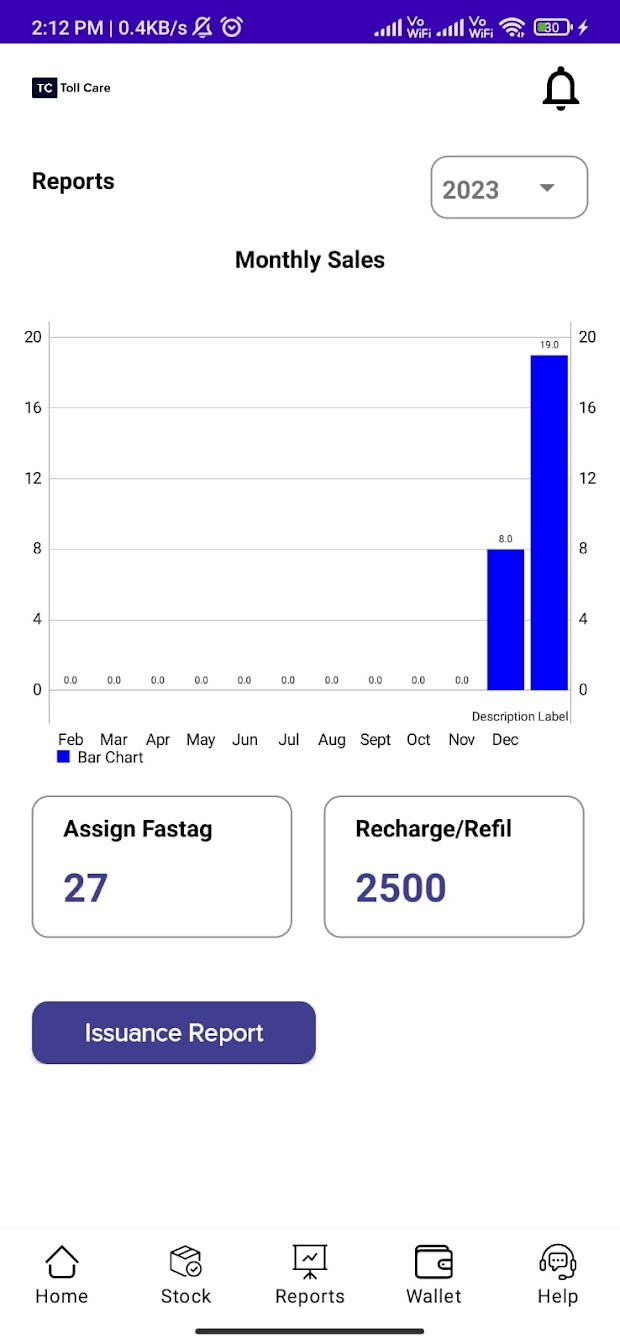
Toll Care Assistant reports screen, with a monthly sales chart and issuance totals
ReportsMonthly issuance and recharge activity, with a report to pull.

The parts of it that are the same in any financial product.

OTP authentication
Field staff sign in on a phone number. Nothing to distribute, nothing to reset, and no shared password sitting in a WhatsApp group.
Inventory by vehicle class
FASTag stock is not one number. It is tracked per class — car and light commercial through to multi-axle — because that is how tags are issued and how they run out.
Assignment and recharge
Issuing a tag to a vehicle and topping one up are the two transactions the business runs on, so they are the two things on the home screen.
Issuance reporting
Monthly activity charted in the app, with an issuance report the operator can pull without asking anyone for an export.
Intelligence, automation & trust

Intelligent Financial Software. Built for Trust.

Three things a financial product has to get right at the same time: work out what is happening, act on it without being asked, and be able to prove afterwards exactly what it did and who authorised it.

How a transaction gets decided

Demo data
  1. 1TransactionReceived
  2. 2AI analysisSignals evaluated
  3. 3Risk scoreScore produced
  4. 4DecisionRule applied
  5. 5ActionRecorded

Transaction

AED 12,450

Al Reem Trading LLC

Card · not present

TXN-44921

Signals evaluated

  • Device and locationKnown
  • Velocity vs. historyNormal
  • Counterparty history14 prior settlements

Risk assessment

LowConfidence 97%

Approved

Cleared automatically. Written to the ledger with the reason code attached.

Illustrative only. Amounts, references and scores above are fabricated for demonstration; a real model is trained and thresholded against your own transaction history and your own risk appetite.

Processor detail representing machine learning applied to financial data
Intelligence

AI that earns its place

Applied where a financial decision is repetitive, high-volume and currently made on intuition. Everything here needs your own data to be worth anything, so we scope it against the history you actually have.

  • AI financial assistantAnswers grounded in the customer’s own ledger, not general text.
  • Fraud and anomaly detectionPatterns across device, velocity, counterparty and channel.
  • Risk scoringCredit, transaction and onboarding risk as a score plus its reasons.
  • Predictive analyticsCash flow, collections and churn projected from your own history.
  • Personalised recommendationsProducts and actions matched to observed behaviour.

Revenue notification arriving on a business laptop
Automation

Work the software should be doing

The finance team’s week is mostly matching, chasing and assembling. Each of those is a rule that can run at 2am, with only the exceptions reaching a person.

  • Automated reconciliationStatements, gateway settlements and ledger matched on rules.
  • Workflow automationApprovals, limits and escalations routed by policy.
  • Scheduled reportingThe pack assembled and delivered instead of rebuilt monthly.
  • Document processingInvoices, statements and KYC documents read and structured.
  • Notifications and alertsThresholds, failures and breaches surfaced when they happen.
Padlock resting on a keyboard, representing financial data protection
Trust

Security as an engineering practice

We build to the security requirements of your business and your regulator. We do not hold certifications on your behalf, and we will not imply we do — what we bring is the engineering that makes an audit survivable.

  • AuthenticationMulti-factor, device binding and session controls.
  • Role-based accessLeast privilege, maker–checker, segregation of duties.
  • Audit trailsEvery state change attributable to a person and a time.
  • Secure APIsSigned requests, scoped tokens, rate limiting, idempotency.
  • Data protectionEncryption in transit and at rest, tokenised sensitive fields.

Have a financial workflow you want to stop doing by hand?

Reconciliation, approvals, onboarding checks, reporting — bring us the one that costs your team the most hours and we will tell you honestly whether software or a model is the right answer.

How we build

From Financial Idea to Production Platform.

Seven phases. The first one is about your business and your regulator, not our code — and the fifth exists because financial software is judged on its worst day.

  1. 01

    Discovery

    How money moves through your business today, which rails you are approved on, which regulator matters, and what the first release has to prove. The phase most financial builds skip and later pay for.

    • Product and workflow map
    • Integration inventory
    • Release sequence
  2. 02

    UX / UI

    Onboarding, verification, the money-moving screen and the screen where a number has to be understood. Designed and tested before they are built, because these are where financial products lose people.

    • Journey and edge-case flows
    • Interface design system
    • Prototype for the critical paths
  3. 03

    Architecture

    The ledger model, the transaction state machine, idempotency, the API contract and where each integration sits. Get this wrong and every later phase pays interest on it.

    • Data and ledger model
    • Service and API design
    • Environment and access plan
  4. 04

    Development

    Built in demonstrable slices — a working payment before a dashboard, a working ledger before a report. You see running software early enough that your feedback still changes something.

    • Fortnightly working builds
    • Staging environment
    • Continuous integration
  5. 05

    Security & testing

    Concurrency on the ledger, duplicate and out-of-order webhooks, failed settlements, partial refunds, access control and the audit trail. Financial software is judged on its worst day, not its average one.

    • Automated and manual test suites
    • Access and permission review
    • Load and failure scenarios
  6. 06

    Launch

    A controlled release with monitoring already running, reconciliation verified against real money, and a rollback that has actually been rehearsed.

    • Production release plan
    • Monitoring and alerting
    • Runbook and support handover
  7. 07

    Scale

    New products, new rails, new markets and deeper automation — with performance work as volume grows rather than after it hurts.

    • Roadmap against real usage
    • Performance and cost tuning
    • Ongoing feature development

What financial software gets built with

Only what we actually use. Payment and banking providers are integrated against whichever vendor you are approved with — see cloud & DevOps.

Mobile
Flutter · React Native · iOS · Android

Customer-facing financial apps, native where the device APIs demand it.

Frontend
React · TypeScript

Consoles, dashboards and admin platforms.

Backend
Laravel · Node.js · Python

Ledger services, APIs and processing workers.

Database
MySQL · MongoDB

Transactional records where consistency matters; documents where it does not.

Cloud
AWS

Environments, scaling, backups and monitoring.

AI
OpenAI APIs · Python ML tooling

Scoring, detection, document extraction and assistants.

Integrations
Payment APIs · banking APIs · third-party APIs

Built against the providers you are already approved with.

Why CodeBuzzers

Financial Software Engineering With Business Outcomes in Mind.

We are a product engineering team, not a licence reseller. The work is judged on whether your operations got faster, your numbers got trustworthy and your customers finished what they started — not on how many features shipped.

Financial software is unusual in one way that shapes everything: the cost of being subtly wrong is higher than the cost of being late. A payment counted twice, a balance that disagrees with the bank, a permission nobody revoked — these are not bugs you patch quietly. So we build slowly where correctness matters and quickly where it does not, and we tell you which is which.

  1. 01

    Secure architecture

    Authentication, least-privilege access, audit trails and encrypted data designed in at the architecture stage — not retrofitted the month before an audit.

  2. 02

    Scalable systems

    A ledger and a transaction model that stay correct under concurrent writes, and infrastructure that grows with volume instead of being rebuilt at the first spike.

  3. 03

    AI where it pays

    Scoring, detection, document extraction and assistants applied to decisions you already make by hand — and an honest answer when your data is not ready for a model yet.

  4. 04

    Custom workflows

    Your approval matrix, your commission structure, your reconciliation rules, your exception path. The parts a licensed product makes you work around.

  5. 05

    Mobile and web as one product

    Customer app, adviser console and admin platform on one data model and one API, so the same transaction is the same record everywhere it appears.

  6. 06

    Cloud infrastructure

    Environments, deployment pipelines, monitoring, backup and recovery set up as part of the build rather than handed over as a diagram.

  7. 07

    Third-party integrations

    Payment gateways, banking APIs, accounting systems, CRM and identity providers — integrated against the vendors you are already approved with.

  8. 08

    Post-launch support

    Monitoring, security patching, dependency updates and continued development. Financial platforms change fastest in the six months after launch.

What clients are actually buying

Stated as directions rather than percentages. We do not have a measured, publishable figure for your business, and inventing one would be the least trustworthy thing on this page.

  • Faster operationsFewer handoffs between systems and people.
  • Better visibilityPosition and exposure as they stand, not at month-end.
  • Less manual workMatching, chasing and assembling handled by rules.
  • Improved customer experienceOnboarding and payments people finish.
  • Infrastructure that scalesVolume growth without a rebuild.
  • Smarter decisionsOne dataset everyone is arguing from.
Dubai skyline, where CodeBuzzers builds financial software for UAE businesses

FinTech Software for Businesses in Dubai and the UAE.

A large share of the work we are asked for in the region is not a new bank — it is a business that already moves money and wants to stop doing it manually. Payment experiences that finish on a phone, financial dashboards that replace a Monday spreadsheet, customer platforms where onboarding and servicing happen in the same place, and back-office automation that removes the parts of the week nobody should still be doing by hand.

As a FinTech software development partner working with Dubai and UAE businesses, we build digital financial products, AI-enabled finance features and secure enterprise systems for companies operating across the GCC — usually alongside an India-based engineering team, which is what keeps a serious build affordable. Financial software development for Dubai has one wrinkle worth naming early: your rails, your licensing and your regulator determine a great deal of the architecture, so we scope against them in discovery rather than discovering them in month four.

Whether you need a FinTech app development company for a customer-facing product, or a financial software development company in the UAE for internal systems, the starting point is the same conversation: what moves, who touches it, and what has to be provable afterwards.

  • Custom financial software
  • Digital payment experiences
  • Financial dashboards
  • AI-enabled finance
  • Secure enterprise systems
Budget

How Much Does Financial Software Development Cost?

We do not publish a price, because the honest answer depends on decisions you have not made yet. What we can do is show you which of those decisions moves the number, and the three shapes an engagement usually takes.

MVP Financial Product

Prove one financial workflow end to end

One product, one customer segment, the shortest honest path to real money moving through real software. Built to be extended rather than thrown away when it works.

  • One customer application
  • Core financial workflow
  • One payment integration
  • Basic admin console
  • Essential reporting
  • Production infrastructure
Most common starting point

Growth Platform

The version an operations team can run a day from

Multiple products or segments, a real admin platform, several integrations, and the automation that stops headcount from scaling with volume.

  • Everything in MVP
  • Customer + admin + staff surfaces
  • Multiple payment and banking integrations
  • Automated reconciliation
  • Full analytics and reporting
  • Role-based access and audit trails

Enterprise Financial Platform

Multi-entity, multi-product, AI-assisted

Several entities, products or markets on one platform, deeper automation, AI trained on your own history, and the integrations your back office and auditors need.

  • Everything in Growth
  • Multi-entity and multi-currency
  • AI scoring, detection and assistants
  • ERP / accounting integration
  • High availability and disaster recovery
  • Ongoing engineering partnership

What actually moves the number

Relative influence on a budget — not prices, and not a percentage of anything.

  • Product complexity

    How many financial workflows the software owns, and how many exceptions each one has.

  • Number of platforms

    Customer app, staff console and admin platform are three products, not three screens.

  • Security requirements

    Access control, audit depth, encryption and whatever your regulator or auditor asks for.

  • Payment integrations

    Collection is the easy half. Payouts, refunds, disputes and reconciliation are the rest.

  • Banking integrations

    Account, statement and transfer APIs — availability depends on your own approvals.

  • AI features

    Rule-based scoring is modest. Trained models depend on history you may not have yet.

  • Admin systems

    The most underestimated part of any financial build, and where operations spends its day.

  • Analytics and reporting

    Live dashboards, statutory reports and exports that reconcile with the ledger.

  • Third-party APIs

    Identity, accounting, CRM, credit data — each with its own contract and edge cases.

  • Infrastructure

    Environments, availability targets, backup and recovery, monitoring.

  • Maintenance

    Patching, dependency updates and continued development after launch.

Get a figure tied to a written scope, not a range.

Tell us what the product does and which integrations are non-negotiable. You will get a scope, a release sequence and an estimate you can take to a board — whether or not you build it with us.

Questions

FinTech & Financial Software Development — Answered.

The questions founders, finance leads and product owners ask us before the first call.

There is no single figure, and any company quoting one before seeing your product is guessing. Cost is driven by how many financial workflows the software owns, how many applications you need (customer, staff, admin), your security and audit requirements, how many payment and banking integrations are in scope, whether AI features are included, and how much analytics and reporting has to reconcile with the ledger. An MVP proving one workflow is a fundamentally different budget from a multi-entity platform. We scope it in discovery and give you a figure tied to a written scope and a release sequence rather than a range on a webpage.

A focused MVP — one customer application, one core financial workflow, a single payment integration and a basic admin console — typically runs a few months. A full platform with multiple surfaces, several integrations, automated reconciliation, a complete admin system and AI features runs considerably longer. We build in demonstrable slices rather than disappearing until the end, so you see working software early enough that your feedback still changes something. Financial builds also carry a testing phase most projects do not: concurrency on the ledger, duplicate webhooks, failed settlements and partial refunds all have to be proven before real money touches the system.

Yes — custom financial software development is the majority of what we do on this page. The reason businesses come to us rather than licensing a product is almost always the same: their approval matrix, commission structure, reconciliation rules or exception handling does not fit the template, and the workaround has become the process. Custom means those rules live in the software instead of in a spreadsheet and a WhatsApp group. If an off-the-shelf product genuinely is the right answer for where you are, we will tell you that too.

Yes. Payment work covers collections across the rails you are approved on, payouts and disbursals, splits and commissions, refunds, chargebacks and disputes, retries and idempotency so a duplicate webhook never double-counts, and settlement reconciliation back against your ledger. We integrate against whichever gateway or provider you have a merchant relationship with rather than reselling one — which rails are available to you depends on your own onboarding and licensing, not on us.

Yes. A lending platform is origination, decisioning, disbursal, servicing and collection, and each stage has its own failure mode. We build digital application capture with document upload, credit rules and scoring integration, approval workflows with limits and escalations, automated repayment schedules and mandates, delinquency and collections workflows, borrower self-service, and the loan book view your credit team works from. Co-lending and partner portals are common additions.

Yes — into a new build or on top of a platform you already run. The applications that pay for themselves fastest are usually fraud and anomaly detection, transaction and credit risk scoring, document extraction from invoices, statements and KYC packs, cash-flow and collections forecasting, and assistants grounded in the customer’s own ledger rather than general text. The honest caveat is that trained models need history: if your data is thin or inconsistent, we will start with rules and instrument the system so a model becomes possible later.

Yes. Payment gateways, banking and account APIs, identity and KYC providers, credit bureaux, accounting and ERP systems, and CRM platforms. Two things matter more than the integration itself: idempotency, so a retried or duplicated message never creates a second transaction, and reconciliation, so what the provider says happened and what your ledger says happened can be compared automatically every day.

Yes, and they are one of the highest-value pieces of a financial build. A dashboard is only as trustworthy as the event model underneath it, so we build them on the live transaction ledger rather than on a nightly export — cash position across accounts and entities, receivables and collections, exposure and limits, product and cohort performance, and the exception queues someone has to work through today. Role-based views mean a CFO, an operations lead and a support agent each see the version of it they need.

As an engineering practice rather than a checklist at the end. Multi-factor authentication, device binding and session controls; role-based access with least privilege, maker–checker and segregation of duties; an audit trail where every state change is attributable to a person and a time; signed, scoped and rate-limited APIs with idempotency; and encryption in transit and at rest with sensitive fields tokenised. What we do not do is claim certifications on your behalf. Compliance obligations belong to your business and your regulator — we build to the requirements they set and make the system straightforward to audit.

Yes. We work with businesses across Dubai, the wider UAE and the GCC, usually alongside an India-based engineering team, which is what keeps a serious build affordable. The work ranges from customer-facing financial products and payment experiences to internal financial dashboards, back-office automation and AI-enabled finance features. The one thing worth naming early is that your rails, licensing and regulator shape a large part of the architecture, so we scope against them during discovery rather than discovering them halfway through the build.

Why businesses choose custom financial software development

The case for a licensed financial product is real: it launches sooner and costs less on day one. What it cannot do is model a business that works differently from the template it was built against — and almost every financial business works differently in at least one place that matters. How commission is split. When a payment is considered final. What happens to a partial refund on a settled batch.

Custom financial software development means those rules live in the system rather than in a spreadsheet and a group chat. The ledger is yours. The approval matrix is yours. The exception path runs the same way at 3am as it does at 3pm, and it is recorded either way.

The second argument is the ledger itself. Most financial pain is not a missing feature; it is two systems that disagree about what happened. A single event model — where a payment, a customer record, a posting and a line on a report are the same fact seen from different angles — is cheap to design at the start and extremely expensive to retrofit.

Then there is everything a licensed product gives you a shallow version of: live operations rather than a nightly export, integrations with the accounting or ERP system your finance team already uses, analytics that reconcile because they come from one source, and AI trained on your own transaction history rather than a generic model. Financial application development lives or dies on reconciliation quality, which is the thing generic products optimise least.

As a FinTech app development company we build the whole product — customer applications, staff and adviser consoles, admin platforms, payment and banking integrations, automation and AI — for financial businesses across India and for clients in Dubai, the UAE and the wider GCC. If you would rather start by mapping what you already have, that is a reasonable first engagement too. You can read more about how we work on about us or talk to the team.

Next step

Tell us what you're building, what financial workflow you're trying to improve, or which part of your customer experience needs to be transformed.

Prefer a written brief? Contact the team.

SettlementDemo data

Amount

₹ 6,74,900

ReceivedTXN-91204
  • Risk checkPassed
  • Ledger postingWritten
  • Accounting entryPosted
  • Customer notifiedSent